
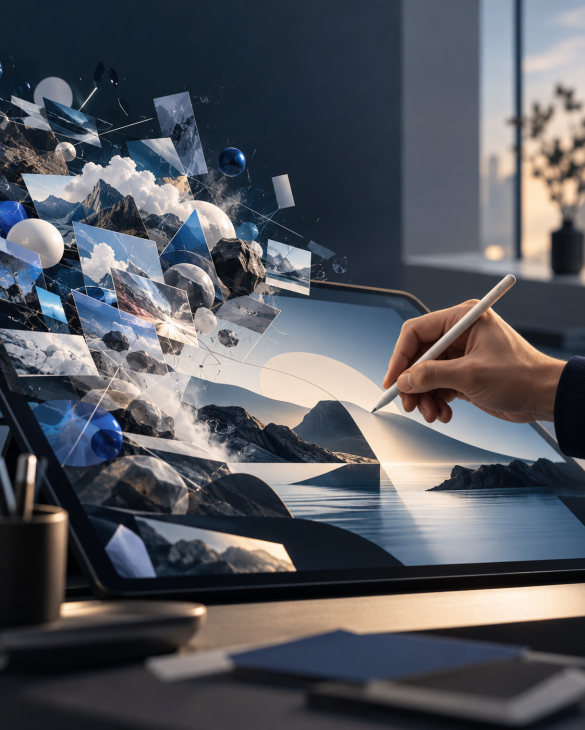
Without editing and art direction,
convenient content quickly becomes visual clutter.
I am approaching this from the perspective of an ordinary AI user who also happens to work in design.
Lately, I have seen a flood of AI-generated posts on Facebook. They range from the viral "who I am and what I do" profile images to political opinions, social commentary and advertisements for products or services.
The problem is that so many of them look the same.
Once you have seen enough dramatic lighting, glowing text, floating icons and exaggerated visual effects, the posts begin to merge into one another. Instead of attracting attention, they create more clutter. People simply scroll past them.
When everything demands attention, nothing gets it
Used at a basic level, AI tends to add too much.
There are often too many captions, icons, visual effects, decorative elements and competing focal points. Everything is trying to be important at the same time.
Good design usually works in the opposite direction. It establishes a clear hierarchy, removes distractions and guides the viewer towards the one thing that matters.
The strongest AI-assisted posts I see are therefore not necessarily the most elaborate ones. They are often the ones that appear to have been edited down.
The brand disappears along the way
The more concerning problem is what AI sometimes does to an established brand.
A company logo may be distorted, redrawn or completely reinvented. Brand colours change. Fonts are replaced. Familiar graphic elements disappear, and the overall visual style no longer feels connected to the business.
A brand is not just its logo. It is the complete visual identity surrounding that logo: the colours, typography, spacing, photographic style, shapes and other supporting elements that make a piece of communication recognisable.
An image may look impressive on its own, but if those elements are lost, it may no longer look like it belongs to the company that published it.
The difference is pushing the image past the first result
Some posts are clearly AI-generated but still manage to stand out. They are more restrained, more focused and better aligned with the brand.
I sometimes wonder whether this happens through sheer luck or whether someone with an eye for design has taken the initial result and continued working on it.
That extra shaping, guiding and editing is what makes the difference.
The first AI-generated image is rarely the finished product. It may need several revised prompts, separate visual elements, retouching, typography, colour correction and careful editing before it becomes usable.
I believe more businesses are beginning to recognise this. They are either putting more effort into refining the output themselves or handing it to someone who can.
How AI fits into my own design work
In my own work, AI can speed up the conceptual stage considerably. It can help explore an idea, test a visual direction or generate individual elements much faster than starting everything from scratch.
I never use the first result as the final artwork.
Instead, I ask AI to produce separate elements and then assemble, edit and finish the design in Photoshop or Illustrator. This gives me greater control over the composition, branding, typography and final production quality.
Some clients have also sent me AI-generated concepts that communicate what they have in mind. I then polish and finalise those ideas using traditional design software.
This can be a very effective working relationship. The client can explore the concept quickly, while the designer ensures that the finished piece is coherent, technically correct and consistent with the brand.
Where AI can make real financial sense
Budgets are tight for many businesses, and AI can reduce the time required to reach a finished result.
Company team photography is a good example.
Arranging professional photographs for 20 or more people across a country or several continents can become a logistical and financial nightmare. Everyone must be available, photographers and locations need to be coordinated, and the resulting images may still vary in lighting, background and quality.
AI-assisted editing can help turn ordinary selfies and existing social-media photographs into a more consistent collection of studio-style profile images.
This process can make a previously impractical project far more affordable.
That is where AI provides genuine value: not simply by producing something flashy, but by solving a real production problem.

Designers are not suddenly unnecessary
I do not believe that all is lost for designers, photographers, illustrators or other creative professionals.
AI can shorten parts of the process, but it does not automatically provide good judgement. Someone still needs to recognise what should be removed, what should be emphasised, whether the composition works and whether the final result represents the brand accurately.
That judgement comes from experience and from spending years making design the main focus of your work.
Most people also do not want to do everything themselves. A business owner may be able to generate an image, but that does not mean they want to spend hours refining it, correcting a damaged logo, matching brand colours or preparing artwork for different platforms and print processes.
Large and successful businesses are not truly one-person operations. They depend on people with different skills and areas of focus.
AI does not remove that need. It changes where some of the time is spent.
The real value is not in generating more content. It is in using AI to reach a strong idea sooner and then applying the judgement, restraint and experience needed to turn that idea into effective design.